Experiment 2: Emergent World Model
Experiment 2: Emergent World Model
Question: When does a pattern's internal state carry predictive information about the environment beyond current observations?
Method: Prediction gap using Ridge regression with 5-fold CV.
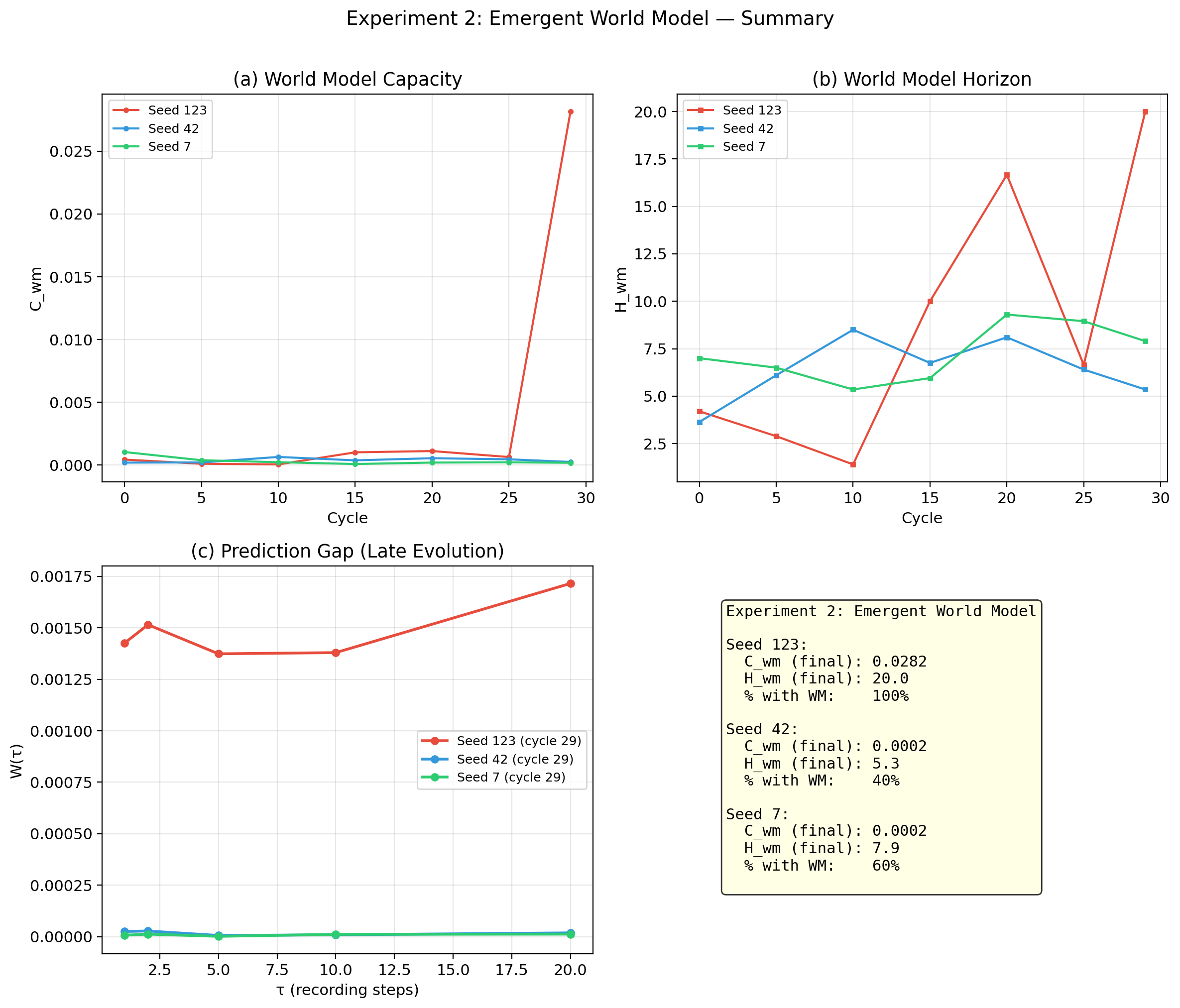
| Seed | (early) | (late) | (late) | % with WM |
|---|---|---|---|---|
| 123 | 0.0004 | 0.0282 | 20.0 | 100% |
| 42 | 0.0002 | 0.0002 | 5.3 | 40% |
| 7 | 0.0010 | 0.0002 | 7.9 | 60% |
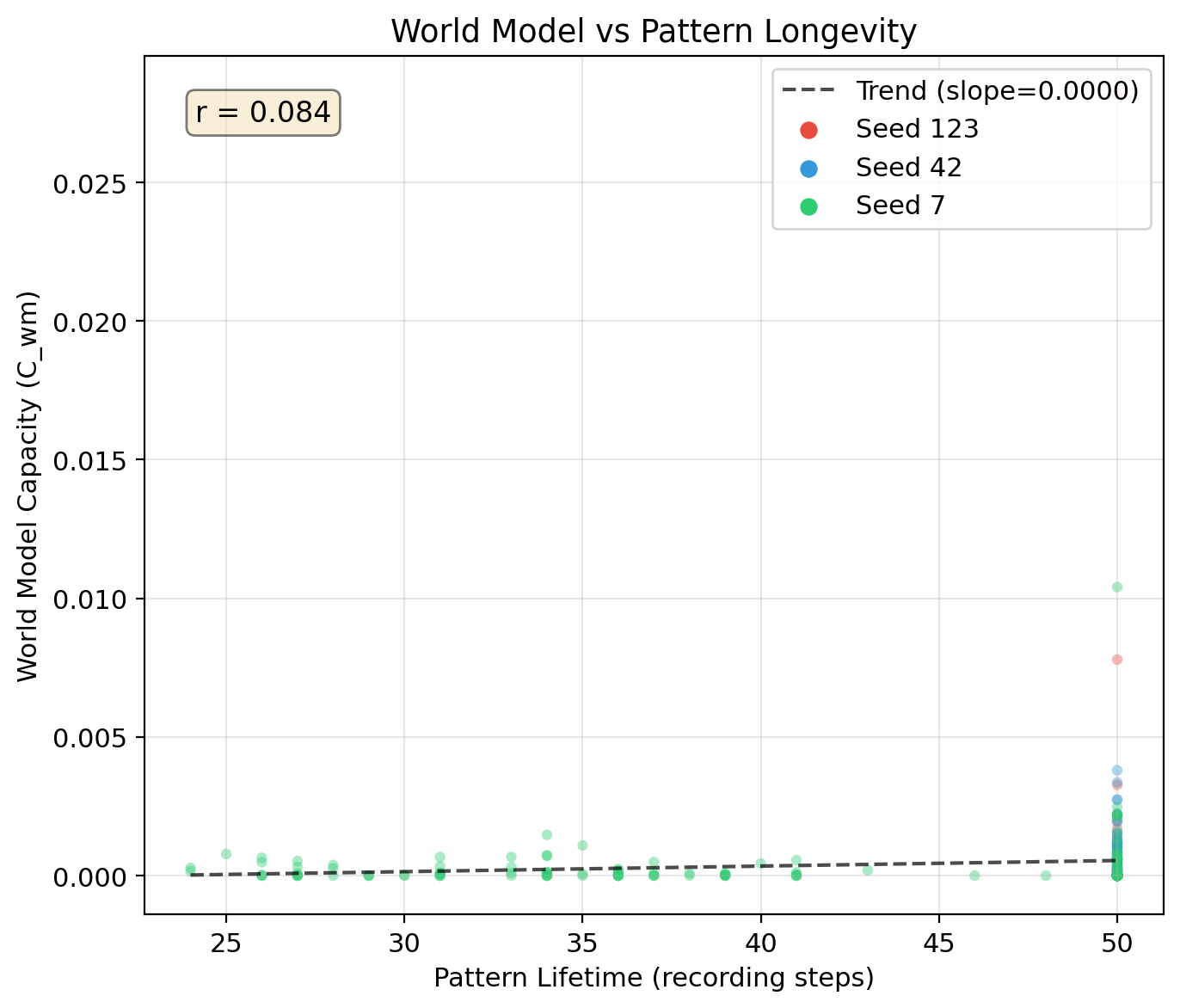
Finding: World model signal present but weak. Seed 123 at bottleneck shows 100x amplification. World models are amplified by bottleneck selection, not gradual evolution. To be clear about magnitude: for most seeds means the internal state predicts the environment barely better than the environment alone. Only seed 123 at maximum bottleneck pressure reaches 0.028 — detectable but still small. These patterns are not building substantial world models; they carry a faint trace of environmental predictive information, amplified briefly under extreme selection.
Source code
v13_world_model.py— World model measurementv13_world_model_run.py— Runnerv13_world_model_figures.py— Visualization