Experiments
Experiment 3: Internal Representation Structure
Experiment 3: Internal Representation Structure
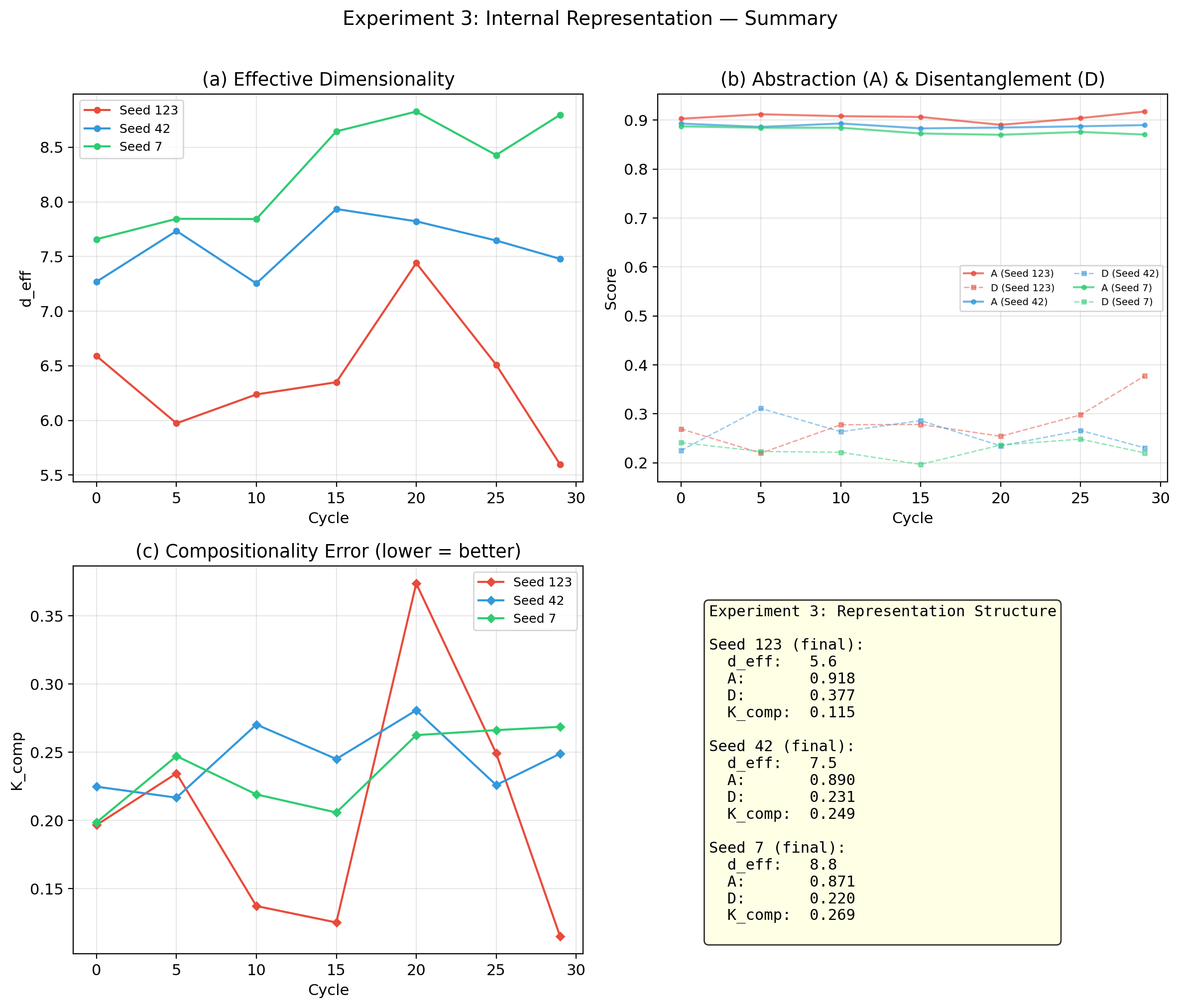
Question: When do patterns develop low-dimensional, compositional representations?
| Seed | (early to late) | |||
|---|---|---|---|---|
| 123 | 6.6 to 5.6 | 0.90 to 0.92 | 0.27 to 0.38 | 0.20 to 0.12 |
| 42 | 7.3 to 7.5 | 0.89 to 0.89 | 0.23 to 0.23 | 0.23 to 0.25 |
| 7 | 7.7 to 8.8 | 0.89 to 0.87 | 0.24 to 0.22 | 0.20 to 0.27 |
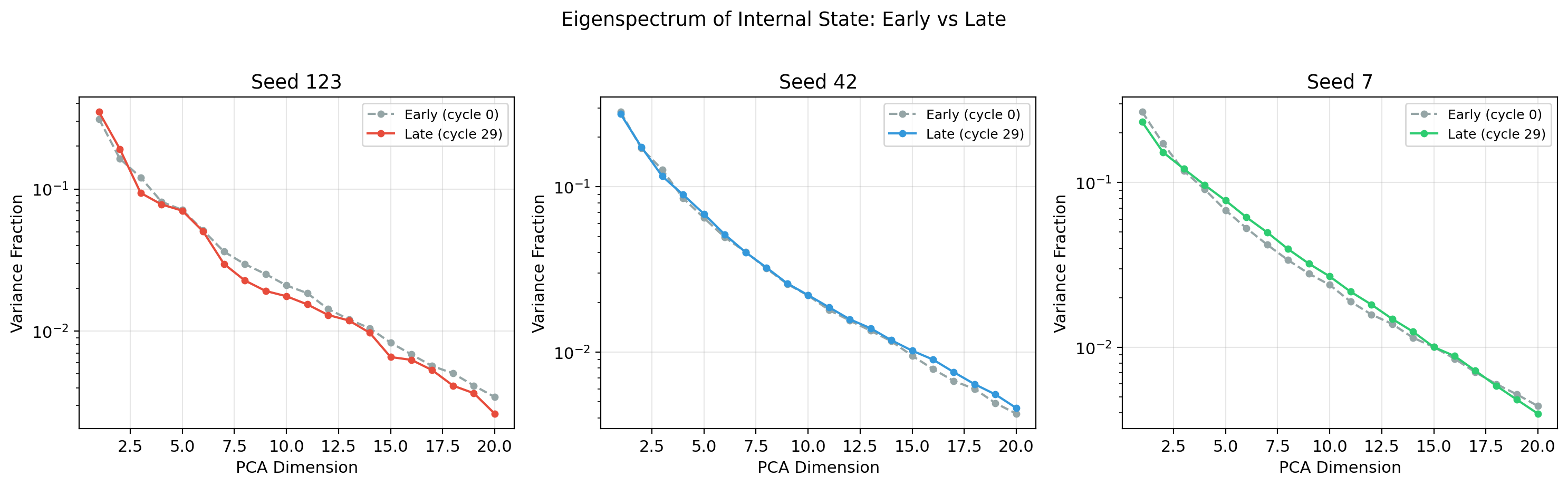
Finding: Compression is cheap — /68 from cycle 0. But quality only improves under bottleneck selection. Note the asymmetry: abstraction () is high and stable from the start — the system compresses efficiently without effort. But disentanglement () remains low — the compressed representations are tangled, not cleanly factored. Disentanglement requires active information-seeking that this substrate lacks.
Source code
v13_representation.py— Representation analysisv13_representation_run.py— Runner